Spray Dryer
Advanced drying technology for converting liquids and slurries into fine, free-flowing powders.

PRODUCT DETAILS
Spray Dryer Manufacturer in India
Laboratory, Pilot and Production Spray Drying Systems
Bombay Pharma Equipments manufactures spray dryers in India for pharmaceutical, chemical, nutraceutical and other process applications. Our laboratory, pilot and production systems are configured around your feed material, evaporation requirement and target powder properties.
Select an open-loop spray dryer for suitable water-based feeds or a closed-loop system for solvent-based and oxygen-sensitive processes. Atomization, powder separation, filtration, cleaning and automation are selected to match the application.
Laboratory, Pilot and Production Spray Dryers
The right spray drying system starts with the scale of your work and the information you need from the process.
Laboratory Spray Dryer
A laboratory spray dryer, also called a lab spray dryer, helps development teams evaluate whether a liquid formulation can produce the required powder. Laboratory trials can explore feed concentration, atomization and drying conditions while generating samples for analysis. Sample quantity, material availability and cleaning requirements should guide system selection.
Pilot Spray Dryer
A pilot spray dryer supports process development between initial feasibility work and production. Pilot trials help assess operating conditions, powder recovery, product consistency and the engineering requirements for scale-up. Results provide a basis for specifying a production system and identifying further development work.
Industrial Spray Dryer
An industrial spray dryer is configured for the required evaporation duty and production schedule. Chamber design, gas handling, heating, powder collection and control functions must work together at the intended operating conditions. Production planning should also account for utilities, cleaning, maintenance access and integration with adjacent equipment.
Open-Loop and Closed-Loop Spray Dryer Options
The carrier liquid and the product's sensitivity to oxygen help determine the process configuration.
Selection factor | Open-loop spray dryer | Closed-loop spray dryer |
Typical starting application | Suitable aqueous feeds | Solvent-containing feeds or oxygen-sensitive products |
Drying medium | Filtered atmospheric air | Recirculating process gas, commonly nitrogen |
Vapour handling | Exhaust treatment appropriate to the process | Condensation and solvent recovery within the gas circuit |
Key design considerations | Air quality, drying conditions, powder separation and exhaust handling | Solvent properties, oxygen control, condensation duty, containment and safety interlocks |
Open-Loop Spray Drying
An open-loop spray dryer draws in fresh air, filters and heats it, and brings it into contact with the atomized feed. Powder is separated from the gas before the exhaust leaves the system through the specified treatment arrangement. This configuration is commonly considered for water-based products where air drying suits the formulation.
Closed-Loop Spray Drying with Solvent Recovery
A closed-loop spray dryer circulates process gas through drying, powder separation, filtration and condensation stages. A nitrogen-based arrangement can maintain the low-oxygen conditions specified for the application, while a condenser recovers solvent from the circulating gas.
Solvent properties, oxygen limits, condenser temperature and interlock requirements are established during process design. The recovery performance depends on the solvent and operating conditions.
Read more about nitrogen spray drying and solvent recovery.
Pharmaceutical Spray Drying Applications
Pharmaceutical spray drying is used to develop and manufacture powders from suitable solutions, suspensions and emulsions. Development teams evaluate the process against the required composition, particle characteristics, residual moisture or solvent, and stability.
Applications for evaluation include:
· Selected pharmaceutical ingredients and intermediates.
· Formulation and excipient development.
· Powder preparation for downstream processing.
· Nutraceutical ingredients and botanical extracts.
· Research samples and pilot batches for process development.
Spray drying is also used for suitable food ingredients, flavours, specialty chemicals and engineered materials. Product suitability and operating conditions should be established through application assessment and trials.
Explore spray dryer applications and products.
How Does a Spray Dryer Work?
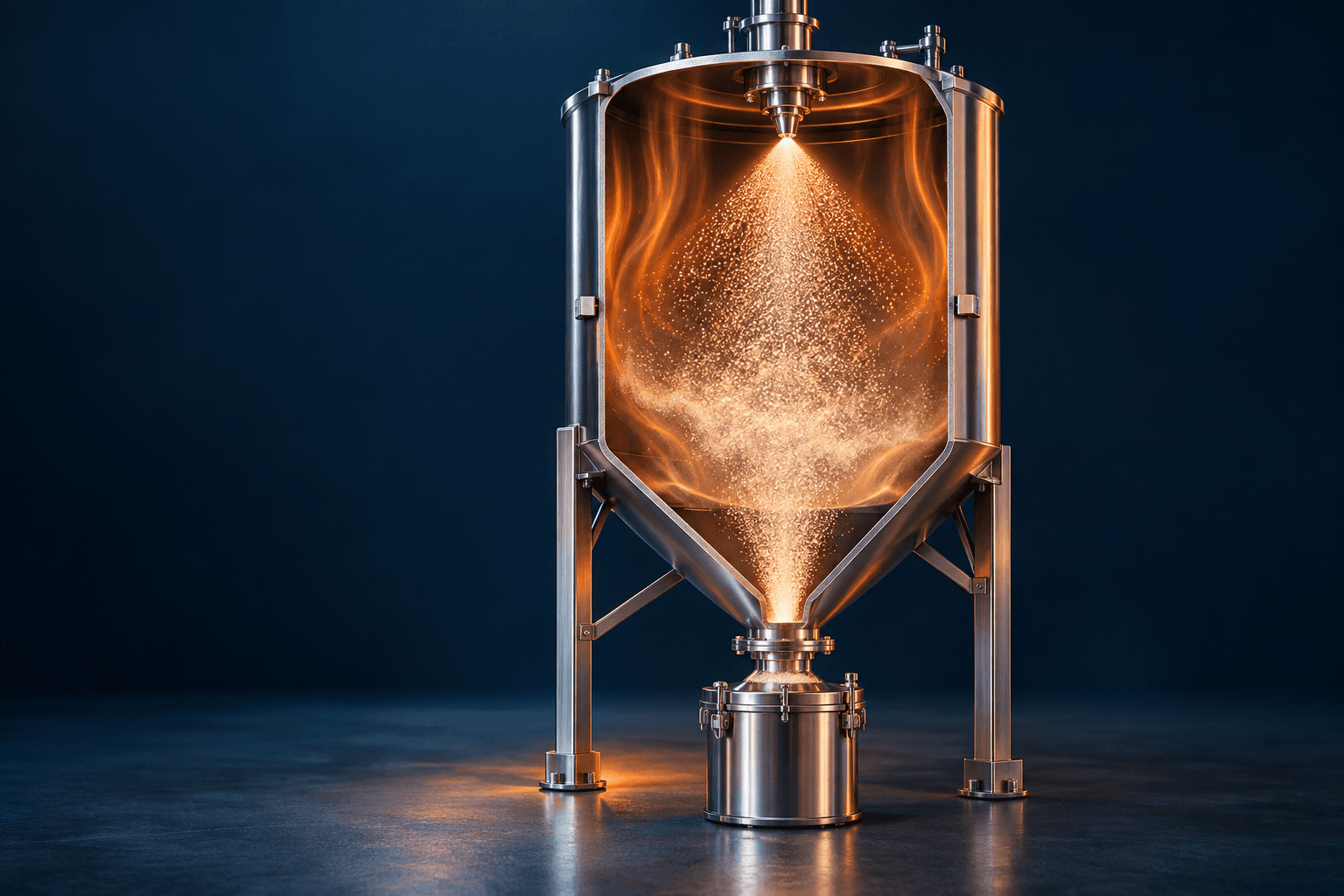
A spray dryer converts a suitable liquid feed into powder by atomizing the feed and evaporating its carrier liquid in a stream of drying gas.
1. Prepare and meter the feed. The feed is supplied at a controlled rate, with concentration, viscosity and temperature appropriate to the process.
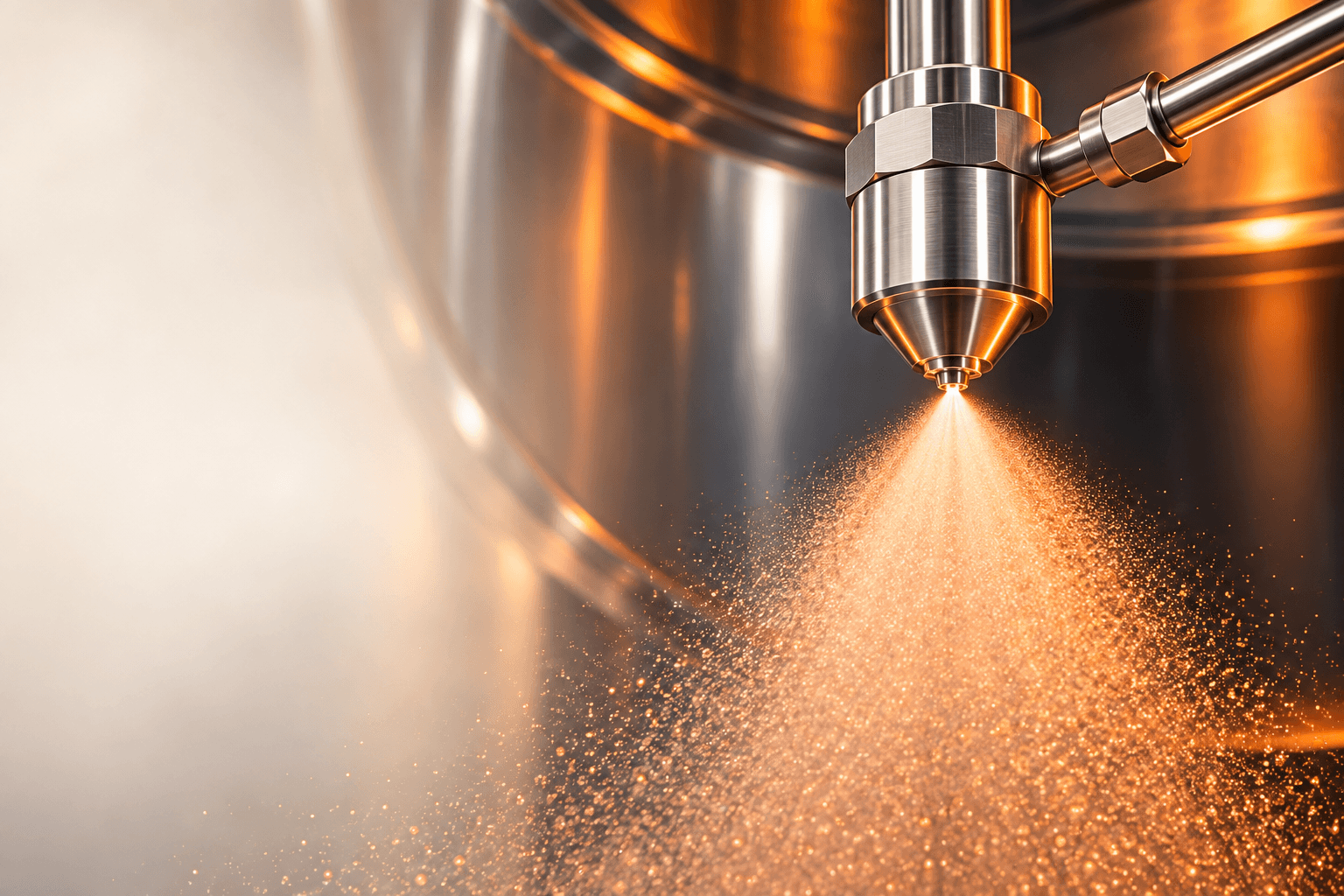
2. Form fine droplets. An atomizer breaks the feed into droplets. Atomizer selection and operating settings influence droplet formation and the resulting particle characteristics.
3. Evaporate the liquid. Droplets contact heated air or process gas in the chamber. Drying conditions are selected to reach the required powder properties while limiting product degradation.
4. Separate and collect powder. The configured chamber outlets, cyclone separators and filters recover particles from the gas stream.
5. Handle the exhaust or recover solvent. An open-loop system treats and discharges the exhaust as specified. A closed-loop system recovers solvent and returns process gas to the drying circuit.
Spray Dryer Features and Configuration Options
The equipment configuration is agreed for the selected model, product and project scope.
Process area | Configuration considerations |
Feed delivery | Pumping and metering selected for feed properties and operating range |
Atomization | Two-fluid nozzle, pressure nozzle or rotary atomizer, selected for the application |
Drying control | Monitoring and control of temperature, gas flow, feed rate and chamber pressure |
Powder recovery | Chamber collection, cyclone separation and fine-particle filtration as configured |
Closed-loop operation | Process-gas circulation, solvent condensation, oxygen monitoring and required interlocks |
Automation | PLC and HMI controls, with SCADA and data functions defined in the automation scope |
Cleaning | Access for inspection and cleaning, with CIP provisions where specified |
Product-contact construction | Materials, surface finish and seals selected for compatibility and cleaning requirements |
Cleaning and Automation for Pharmaceutical Processing
Cleaning requirements influence the design of the chamber, ducting, collection vessels and filters. Access for inspection, product changeover and removal of retained powder should be considered when specifying the system. Clean-in-place provisions can be discussed for the selected configuration; cleaning performance must be demonstrated for the intended product and procedure. For pharmaceutical projects operating under cGMP, define the required construction, cleaning and documentation in the user requirement specification.
Automation requirements may include process setpoints, recipes, alarms, trends and operating records. For projects requiring electronic records, define user permissions, audit trails, data retention and electronic signatures in the user requirement specification. Functions intended to support 21 CFR Part 11 requirements must be agreed, implemented and validated for their intended use.
Read about CIP system integration in spray dryers.
Why Choose Bombay Pharma Equipments?
Bombay Pharma Equipments' spray dryer development is backed by three years of research and development. Our approach brings the equipment discussion back to the requirements of your product and manufacturing process.
· Configuration around your feed: Discuss the liquid carrier, solids content, viscosity and product sensitivity before selecting the drying arrangement.
· Development through production: Evaluate laboratory, pilot and production requirements as part of the project plan.
· Integrated process design: Consider atomization, powder recovery, gas handling, cleaning and controls together.
· Project support: Define the scope for manufacturing, testing, installation and commissioning alongside the equipment specification.
What Determines Spray Dryer Capacity and Price?
Spray dryer capacity is linked to the amount of liquid that must be evaporated under defined conditions. Feed throughput and dry powder output are separate quantities: both depend on feed composition, solids concentration and the operating basis.
The price of a spray dryer depends on its scale, evaporation duty, atomization system, materials, automation, cleaning provisions and gas-handling requirements. A closed-loop nitrogen system with solvent recovery has a different equipment scope from an open-loop air-drying system. Share your process details to receive a configuration-specific quotation.
Discuss Your Spray Drying Project
Help us understand the process you want to develop or scale. Include the following details in your enquiry:
· Product name, liquid carrier and relevant material properties.
· Feed quantity, solids concentration and intended operating schedule.
· Required powder output, particle size and residual moisture or solvent targets.
· Heat sensitivity, oxygen sensitivity and containment requirements.
· Available utilities, installation space and cleaning needs.
· Required controls, data functions and project timeline.
Contact Bombay Pharma Equipments to discuss a laboratory, pilot or production spray dryer configured for your application.
Learn how two-fluid nozzle atomization influences spray formation and process selection.
Frequently Asked Questions About Spray Dryers
What is a spray dryer used for?
A spray dryer produces powder from a suitable liquid feed, such as a solution, suspension or emulsion. Applications include pharmaceutical ingredients, nutraceuticals, food ingredients and specialty chemicals. The formulation and process conditions determine whether the required powder can be produced.
What is the difference between open-loop and closed-loop spray drying?
Open-loop spray drying uses fresh drying gas and discharges treated exhaust. Closed-loop spray drying recirculates process gas and can include solvent condensation and recovery. A nitrogen-based closed loop is considered where solvent properties or oxygen sensitivity require a controlled low-oxygen process.
How do I choose between a laboratory, pilot and industrial spray dryer?
Choose according to the development stage, available feed, evaporation requirement and intended production output. Laboratory systems support feasibility work, pilot systems support process development, and industrial systems address production duty. Trial results help establish the design basis for scale-up.
Can spray drying be used for heat-sensitive products?
It can be suitable for some heat-sensitive materials because evaporation and drying occur over a short period. Suitability depends on the formulation, product temperature, residence time and degradation behaviour. Trials are needed to identify operating conditions and confirm product quality.
What particle size can a spray dryer achieve?
There is no single particle-size range that applies to every spray dryer and formulation. Feed properties, atomizer design, atomization settings and drying conditions influence the result. Specify the required size distribution and verify it through suitable trials and particle-size analysis.
Can a spray dryer recover organic solvents?
A closed-loop system can incorporate condensation to recover solvent from the circulating gas. Recovery depends on solvent composition, vapour loading, condenser conditions and the complete system design. The process must also address the solvent's flammability, compatibility and handling requirements.
Can CIP be integrated into a spray dryer?
CIP provisions can be incorporated where the equipment and product are suitable. The cleaning arrangement must address the chamber, product-contact connections and collection system. Cleaning coverage, residues, drainage and the required procedure should be assessed for the intended application.
How can I get a spray dryer quotation?
Send Bombay Pharma Equipments your feed composition, solvent or water content, solids concentration, quantity to process and required powder characteristics. Include the operating scale, cleaning needs, utilities and automation requirements so the proposed scope and quotation can be developed around your application.

INSIGHTS & ARTICLES
Latest from our blog





PRODUCT INQUIRY
Need this equipment
for your process?